
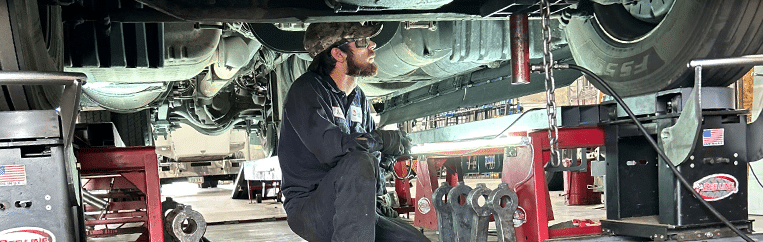
TRUCK WHEEL ALIGNMENT 101
por Betts Marketing Staff
Una alineación adecuada de las ruedas de los semirremolques es importante para mantener el bienestar general de su vehículo comercial. Una mala alineación puede provocar un desgaste prematuro de los neumáticos y un mal ahorro de combustible.
A misaligned truck burns more fuel to go the same distance, wears expensive tires down unevenly instead of flat, and puts more strain on steering and suspension components that are not cheap to replace early. For fleets running tight margins, alignment is one of the few maintenance items that pays for itself.
If you’re ready to book a laser alignment at one of our 8 West Coast locations, you can schedule truck wheel alignment service here.
Otherwise, here’s what you actually need to know about truck and trailer alignment, what causes it to go wrong, and how to catch it before it costs you a set of tires.
ALINEACIÓN EN CIFRAS
Misalignment costs real money in fuel and tire replacement, and the numbers add up faster than fleet managers expect.
Based on a tractor running 65,000 miles a year at 6 mpg with diesel at $5.88/gallon (the West Coast average), and a trailer running 60,000 miles a year, a properly aligned truck and trailer combination can save:
Fuel savings: $1,274/year
Truck tire savings (steer and drive): $1,268/year
Trailer tire savings: $576/year
Total annual savings: $3,118/year
These figures assume a 2% fuel economy improvement and 30% extended tire life after alignment, using $600 steer tires, $500 drive tires, and $400 trailer tires, with an 80,000-mile average life for steer and drive tires and a 100,000-mile average life for trailer tires.
Run your own fleet’s numbers with Bee Line’s fleet savings calculator.
WHAT ALIGNMENT ACTUALLY MEANS: CAMBER, CASTER, AND TOE
Most explanations of wheel alignment stop at “your wheels aren’t straight,” which does not tell you much.
A real alignment adjusts three separate angles, and each one fails differently.
Camber is the inward or outward tilt of the wheel when you look at the truck head on. Too much positive camber wears the outside edge of the tire. Too much negative camber wears the inside edge.
Caster is the forward or backward tilt of the steering axis. It’s what makes a truck track straight and return to center after a turn instead of wandering. Bad caster shows up as a truck that feels unstable at highway speed or pulls when you take your hands off the wheel.
Toe gets blamed the least and causes the most damage. It’s whether the front of the tires point slightly in or out relative to each other when viewed from above, and it’s the angle most responsible for fast, uneven wear across the whole tread rather than just one edge..
A proper alignment measures and corrects all three on every axle, not just the front.
SEÑALES DE QUE NECESITA UNA ALINEACIÓN DE RUEDAS
Estas señales (a continuación) son indicativas de posibles problemas con la alineación de las ruedas. Es esencial que preste atención a estas señales y que haga inspeccionar su vehículo por un profesional si nota alguno de estos síntomas para asegurarse de que su camión o remolque mantiene una alineación adecuada para una conducción segura y sin problemas.
- El vehículo se desvía o tira hacia un lado.
- Posición del volante desactivada
- Volante torcido
- Neumáticos chirriantes
- Duda en la dirección
- Desgaste irregular de los neumáticos
- Vibración
DIFERENTES TIPOS DE DESGASTE DE LOS NEUMÁTICOS Y SU SIGNIFICADO
Diversos tipos de desgaste irregular de los neumáticos pueden indicar problemas específicos con la suspensión, la alineación u otros componentes mecánicos del vehículo.
Reconocer estos patrones de desgaste puede ayudar a diagnosticar problemas subyacentes en los componentes del vehículo. Las inspecciones periódicas de los neumáticos, el inflado adecuado, las comprobaciones de alineación y el mantenimiento oportuno son cruciales para garantizar un desgaste uniforme de los neumáticos y maximizar su vida útil.
Any of these wear patterns showing up on a drive axle or trailer axle can also point back to worn suspension or spring components rather than alignment alone. If your chassis inspection turns up worn leaf springs or bushings, that needs to be fixed before an alignment will hold, since aligning a truck on worn suspension parts just means it goes out of alignment again in a few thousand miles.
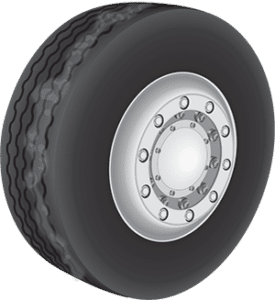
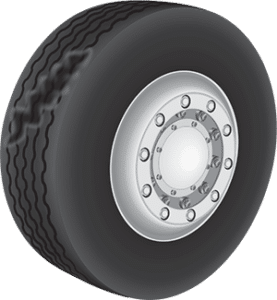
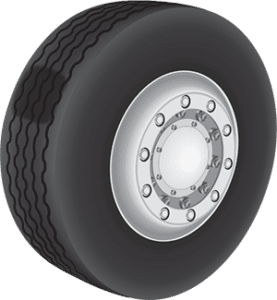
Estos son algunos ejemplos comunes de patrones de desgaste de los neumáticos:
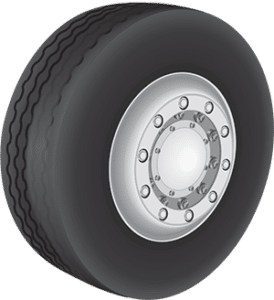
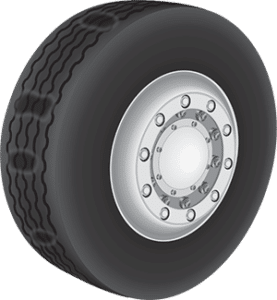
Desgaste por ventosas: Loss of tire-to-road contact due to worn suspension components creates vibrations that result in tire bounce, leading to a series of high and low spots on the tire tread.
¿CON QUÉ FRECUENCIA DEBEN REALIZARSE LOS SERVICIOS DE ALINEACIÓN DE SEMIRREMOLQUES?
Recomendamos que se realice un servicio inicial de alineación de camiones entre las primeras 15.000 y 30.000 millas de vida de un camión, o después de los primeros tres meses, lo que ocurra primero. También es importante comprobar la alineación si se observa un desgaste irregular de los neumáticos o si el conductor informa de problemas de dirección o manejo. La alineación también debe comprobarse cada vez que el vehículo haya sufrido daños, o si se han sustituido componentes que afectan a la alineación.
TRACTOR ALIGNMENT VS. TRAILER ALIGNMENT: WHY THEY’RE NOT THE SAME JOB
A lot of drivers assume alignment is just a front-end truck service, the same as it would be on a pickup. On a tractor-trailer, that’s only half the picture.
Tractor alignment deals with steer axle and drive axle angles, the components covered above. Trailer alignment is a different problem entirely: it’s about whether the trailer’s axles track straight behind the tractor. A trailer that’s out of alignment causes dog tracking, where the trailer runs slightly sideways down the road instead of directly behind the cab. In crosswinds or hard braking that’s a stability problem plus a tire wear problem.
If you’re only aligning the tractor and skipping the trailer, you’re fixing half the problem. We check and align both, and if your fleet runs the same tractor with different trailers, it’s worth having each trailer checked independently since they don’t all wear the same way.
WHAT HAPPENS DURING A BETTS LASER ALIGNMENT
Here’s what an appointment actually looks like, start to finish:
We raise the vehicle and inspect the chassis first, checking leaf springs, king pins, wheel bearings, and steering linkage before touching the alignment itself. If something’s worn out, we tell you before we align around it, not after.
We measure camber, caster, and toe on every axle using computerized Bee Line laser alignment equipment, which is more accurate than the shops still using tape measures and string.
We correct what’s out of spec and print out a before and after report showing the exact numbers, so you’re not just taking our word for it.
The whole process typically fits into a single appointment, Monday through Friday (8 AM to 5 PM for most of our branches), at any of our 8 West Coast locations.
Improper alignment doesn’t fix itself, and it rarely gets cheaper to ignore. If you’re seeing uneven tire wear, a truck that pulls, or you’re just due based on mileage, schedule an alignment appointment at your nearest Betts location.
Nuestra misión es Seguimos ganándonos su confianza, milla tras milla¡! ®
WHAT IS TRUCK WHEEL ALIGNMENT?
Truck wheel alignment is the process of adjusting a truck’s suspension angles, camber, caster, and toe, so the wheels meet the road correctly. It’s not just about the steering wheel sitting straight. On a heavy-duty truck, that means checking and correcting these angles on every axle, not just the front.
WHAT'S THE DIFFERENCE BETWEEN CAMBER, CASTER, AND TOE?
Camber is the inward or outward tilt of the wheel. Caster is the forward or backward tilt of the steering axis, which affects how the truck tracks and returns to center after a turn. Toe is whether the tires point slightly in or out relative to each other, and it’s usually the biggest factor in fast, uneven tread wear. A full alignment corrects all three.
IS TRAILER ALIGNMENT DIFFERENT FROM TRACTOR ALIGNMENT?
Yes. Tractor alignment covers the steer and drive axles. Trailer alignment is a separate check on whether the trailer’s axles track straight behind the tractor.
A trailer that’s out of alignment can cause dog tracking, where it runs slightly sideways down the road, which is a handling and safety issue as much as a tire wear one.
CAN HITTING A POTHOLE OR CURB THROW OFF MY ALIGNMENT?
Yes. A hard hit to a wheel, whether from a pothole, a curb, or a shifted load, can knock one or more angles out of spec even if nothing looks visibly damaged. If you hit something hard and then notice a pull, vibration, or uneven wear afterward, get the alignment checked instead of waiting for it to get worse.
HOW OFTEN SHOULD A SEMI TRUCK GET AN ALIGNMENT?
We recommend an initial alignment between 15,000 and 30,000 miles, or within the first three months, whichever comes first. After that, check it any time you notice irregular tire wear, steering or handling problems, or after the vehicle has been damaged or had suspension components replaced.
HOW OFTEN SHOULD A SEMI TRUCK GET AN ALIGNMENT?
We recommend an initial alignment between 15,000 and 30,000 miles, or within the first three months, whichever comes first. After that, check it any time you notice irregular tire wear, steering or handling problems, or after the vehicle has been damaged or had suspension components replaced.
 English
  Español de México
  Українська
  ਪੰਜਾਬੀ